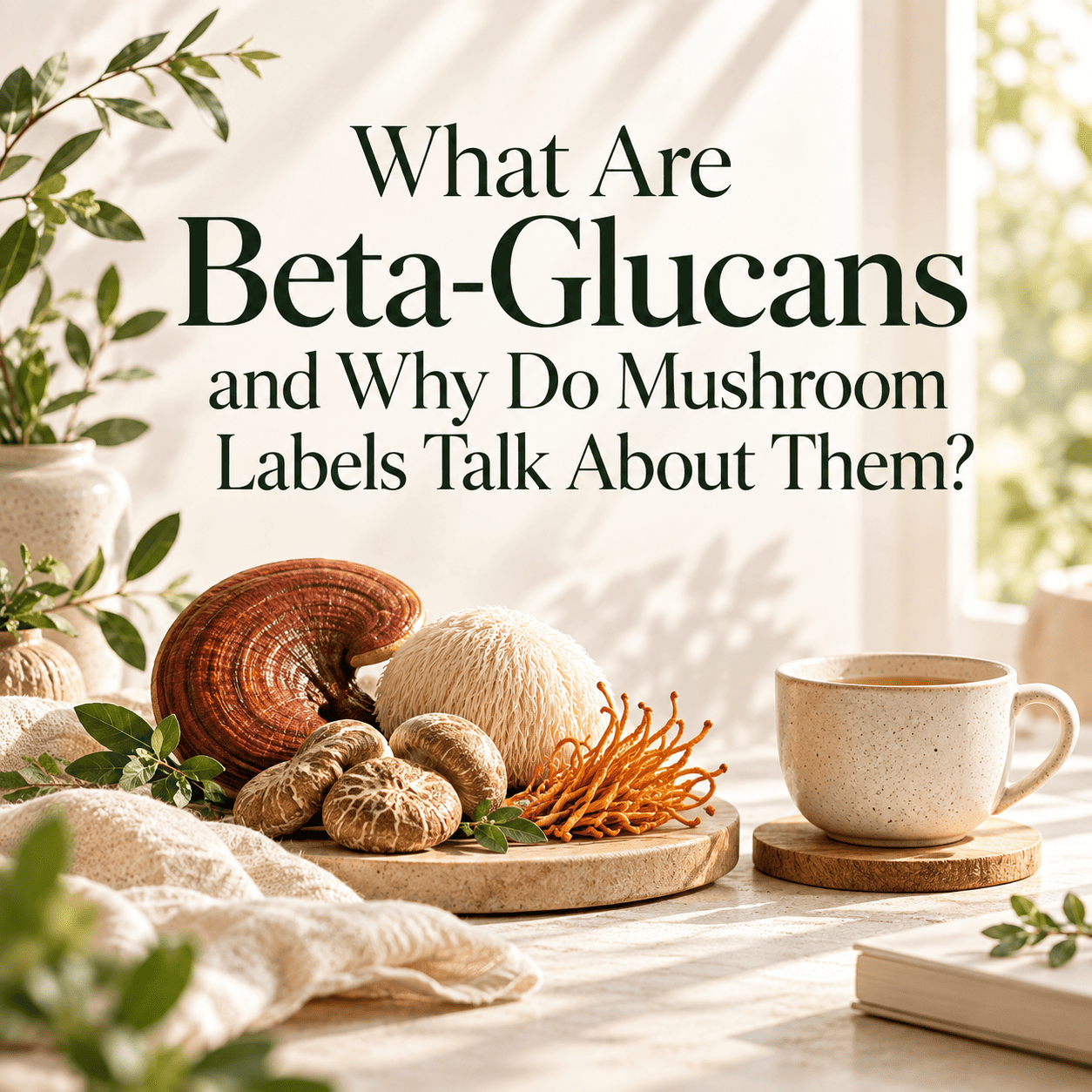
What Are Beta-Glucans and Why Do Mushroom Labels Talk About Them?

Published:
Beyond the label.
Understand beta-glucans.
Not all beta-glucans are the same. Discover what those numbers and terms really mean—and what to look for when choosing functional mushrooms.
The essentials, before you dive in.
- Beta-glucans are natural polysaccharides found in mushrooms and other foods.
- Their structure varies by source, so the name alone does not describe one identical ingredient.
- Read beta-glucan content alongside the species, product format, source and quality information.
If you have ever compared functional mushroom powders, mushroom extracts or mushroom supplements, you may have noticed one term appearing again and again:
Beta-glucans.
Some mushroom products highlight beta-glucan percentages prominently on their packaging. Others mention polysaccharides, mushroom extracts or active compounds.
But what exactly are beta-glucans?
Are all beta-glucans the same?
And does seeing “beta-glucan” on a mushroom label automatically mean that one product is better than another?
Here is a simple guide to understanding one of the most talked-about compounds in functional mushrooms.
🛒 Shopping for mushroom powders? Browse the ViveNutri range while you read: Browse the ViveNutri mushroom powder range
What Are Beta-Glucans?
Beta-glucans are naturally occurring polysaccharides, which are long chains made from glucose molecules.
They are found in several natural sources, including:
- mushrooms
- yeast
- oats
- barley
- certain algae
- some bacteria
However, beta-glucans from different sources are not structurally identical.
This is important because their biological properties can vary depending on their molecular structure, branching pattern, solubility and source. Research on fungal beta-glucans, for example, commonly focuses on beta-(1,3) glucans with beta-(1,6) branching.
In simple terms:
“Beta-glucan” is not one single substance. It is a family of related natural compounds.
Where Are Beta-Glucans Found in Mushrooms?
Beta-glucans are naturally present in the cell walls of fungi, including mushrooms.
They form part of the mushroom’s structural framework and are one reason functional mushrooms have attracted so much scientific interest.
Different mushroom species can contain different amounts and structures of beta-glucans.
For example, researchers have studied beta-glucans found in mushrooms such as:
- Reishi
- Shiitake
- Oyster Mushroom
- Lion’s Mane
- Maitake
The exact composition can vary depending on the species, the part of the mushroom used, growing conditions and how the final ingredient is processed.
Why Are Beta-Glucans So Common on Mushroom Labels?
Consumers increasingly want to know what is actually inside a functional mushroom product.
Because beta-glucans are naturally occurring components of fungal cell walls, manufacturers may use beta-glucan content as one way of describing or standardising a mushroom ingredient.
This is why you may see labels mentioning:
“Contains beta-glucans”
or
“Standardised beta-glucan content.”
It gives consumers another piece of information beyond simply seeing the name of the mushroom on the front of the packaging.
However, beta-glucan percentage should not be the only thing you look at.
A mushroom product should be evaluated as a whole.
Are All Beta-Glucans the Same?
Oats & barley
Commonly feature β-(1,3) and β-(1,4) linkages.
Mushrooms & yeast
Often feature a β-(1,3) backbone with β-(1,6) branches.
No.
This is one of the most important things to understand.
The beta-glucans found in cereal grains such as oats and barley are structurally different from those commonly found in mushrooms and yeast.
Oat and barley beta-glucans mainly contain beta-(1,3) and beta-(1,4) linkages and are well known as forms of soluble dietary fibre.
Fungal beta-glucans commonly contain a beta-(1,3) backbone with beta-(1,6) branching.
So although both may be called beta-glucans, their structures — and therefore their functions in the body — can be different.
This is why simply comparing two products based only on the words “beta-glucan” can be misleading.
Why Are Mushroom Beta-Glucans Interesting to Researchers?
One of the most researched areas involving fungal beta-glucans is their interaction with the immune system.
Certain immune cells contain receptors capable of recognising fungal beta-glucan structures.
One of the best-studied receptors is called Dectin-1, which helps immune cells recognise specific fungal beta-glucans and initiate downstream immune signalling.
This does not mean that every mushroom product will have the same biological effect.
Human research on fungal beta-glucans has produced promising findings, particularly in areas involving immune modulation, but results can vary depending on the source, structure, dose, preparation and population studied. Reviews of clinical research also note that more work is still needed to establish optimal doses and fully understand their effects.
That distinction is important.
Good nutrition education should explain what the science suggests without turning every early finding into a health promise.
Beta-Glucans vs Polysaccharides: Are They the Same?
You may also see the word polysaccharides on mushroom products.
Beta-glucans are a type of polysaccharide, but not all polysaccharides are beta-glucans.
Think of it this way:
Polysaccharides = the larger category
Beta-glucans = one group within that category
A mushroom may naturally contain many different polysaccharides and other bioactive compounds.
So when a label says “high polysaccharides”, that does not necessarily mean the same thing as saying it contains a specific percentage of beta-glucans.
This is one reason it is worth reading mushroom labels carefully.
Does a Higher Beta-Glucan Percentage Always Mean a Better Mushroom Product?
Not necessarily.
It can be useful information, but quality cannot always be reduced to one number.
Scientists studying mushroom beta-glucans have found that biological activity may be influenced by several structural characteristics, including:
- molecular weight
- branching pattern
- solubility
- molecular configuration
- mushroom species
- extraction method
Researchers are still working to understand exactly how these structural differences influence biological activity.
This means that comparing two mushroom products purely by saying:
“70% must automatically be better than 50%”
may oversimplify the science.
The source and quality of the mushroom still matter.
What Else Should You Check on a Mushroom Label?
Five things to check before choosing a functional mushroom product.
Beta-glucan content can be useful, but it should be considered together with other information.
Before buying a functional mushroom product, look at:
1. The Mushroom Species
Look for both the common name and scientific name where possible.
Examples include:
Lion’s Mane — Hericium erinaceus
Tiger Milk Mushroom — Lignosus rhinocerus
Reishi — Ganoderma lucidum
Knowing the scientific name helps you understand exactly which mushroom species you are purchasing.
2. The Ingredient List
Check whether the product contains:
- 100% mushroom powder
- mushroom extract
- multiple mushroom species
- sweeteners
- flavourings
- fillers
- other functional ingredients
The front of a package may focus on marketing messages.
The ingredient list tells you what is actually inside.
3. Powder or Extract?
Whole mushroom powder and mushroom extracts are not necessarily the same thing.
A mushroom powder is generally produced by drying and milling mushroom material.
An extract involves additional processing designed to concentrate or isolate selected compounds.
Neither format is automatically better for every consumer.
They are simply different product formats.
4. Source and Cultivation
Mushrooms are biological materials.
Species, growing conditions, substrate, harvesting and processing can all influence the final product.
If a manufacturer provides transparent information about how its mushrooms are cultivated and processed, that can help consumers make more informed choices.
5. Quality Testing
Where available, look for information relating to:
- identity testing
- ingredient purity
- microbial testing
- heavy metal testing
- beta-glucan analysis
- other relevant quality-control measures
Testing provides useful information about consistency and product quality.
Beta-Glucans in Functional Mushrooms
Functional mushrooms have become increasingly popular because they naturally contain a wide variety of compounds, including polysaccharides and beta-glucans.
At Grusonn Wellness, the ViveNutri range includes several mushroom powders such as Tiger Milk Mushroom, Lion’s Mane, Reishi, Cordyceps, Shiitake and Oyster Mushroom.
Rather than viewing functional mushrooms through a single compound, it can be more useful to understand the mushroom as a complete natural ingredient.
Beta-glucans are important.
But they are only one part of a much bigger picture.
🍄 Featured: ViveNutri Tiger Milk Mushroom Powder — 100% organic Tiger Milk Mushroom (Lignosus rhinocerus), Malaysia’s native mushroom. 👉 Shop now: Shop ViveNutri Tiger Milk Mushroom Powder
What About Tiger Milk Mushroom?
Tiger Milk Mushroom, scientifically known as Lignosus rhinocerus, has a particularly strong connection with Southeast Asia and Malaysia.
Grusonn’s ViveNutri Tiger Milk Mushroom Powder currently contains 100% organic Tiger Milk Mushroom powder, according to the product information published on the Grusonn website.
Tiger Milk Mushroom also contains naturally occurring polysaccharides and other bioactive compounds that have contributed to growing scientific interest in the species.
For consumers comparing functional mushroom products, this is where understanding terminology such as polysaccharides, beta-glucans, mushroom powder and mushroom extract becomes useful.
You are no longer simply choosing a product based on a mushroom picture on the front of the package.
You are learning how to understand what is actually inside.
So, Should You Look for Beta-Glucans When Buying Mushroom Products?
Yes — but treat beta-glucan information as one piece of the puzzle, rather than the entire measure of quality.
A more complete approach is to ask:
What mushroom species is being used?
What form is it in?
How was it cultivated and processed?
What does the ingredient list contain?
Has the product undergone appropriate quality testing?
And what does the beta-glucan information actually refer to?
The more transparent the label, the easier it becomes to make an informed choice.
Final Thoughts
Beta-glucans may sound highly technical, but the basic idea is simple.
They are naturally occurring polysaccharides found in mushrooms and several other foods.
In mushrooms, their unique structures have attracted significant scientific attention, particularly because of how certain fungal beta-glucans interact with the immune system.
But not all beta-glucans are identical, and a higher percentage on a label does not automatically tell you everything about the quality of a functional mushroom product.
The next time you pick up a mushroom powder or supplement, look beyond the front of the package.
Check the mushroom species.
Read the ingredient list.
Understand whether you are buying a powder or extract.
Look for quality information.
And when you see “beta-glucan” on the label, you will know what it actually means.
🍄 Ready to Put What You’ve Learned Into Practice?
Now that you know what beta-glucans really mean on a label, choose a mushroom powder that tells you exactly what’s inside.
✅ Organic functional mushroom powders by Grusonn Wellness
✅ Grown on a highland organic farm in Malaysia
✅ Simple powder format that fits into everyday drinks and meals
👉 Shop ViveNutri Tiger Milk Mushroom Powder: Shop ViveNutri Tiger Milk Mushroom Powder
👉 Browse the full ViveNutri mushroom range: Browse the ViveNutri mushroom powder range
📖 Keep reading: Are Functional Mushrooms Really Worth It? Read: Are Functional Mushrooms Really Worth It?
Meet the mushrooms
behind the label.
Now that you know what to look for, explore ViveNutri mushroom powders directly.
 Tiger Milk Mushroom
 Lion’s Mane
 Reishi
 Shiitake
This article is for general educational purposes only and is not intended to diagnose, treat, cure or prevent any disease. Individual nutritional needs may vary.